



15 of the most interesting albums of January and February 2025. In this issue: Dream Theater in two different incarnations; a whole crowd of popular indie rock acts decided to release their rather uniform albums right at the start of 2025 - and collectively slipping on a banana peel (okay, a couple of them still crawled into the top); and in the finale, two aesthetic girls face off over whose style is more refined and elegant - a Norwegian with an Emirati background, or a Frenchwoman with Armenian roots. Nothing can top the best song of 2025 at this point, but we can at least try to dig up some other music worth hearing.
15. Zalia - Serce
🇵🇱 Poland / February 20 / 0,768 / 🌟
Spotify / Apple Music / Yandex Music
alt-pop / indie pop
The first record in today’s digest comes from Julia Zarzecka, better known by her sleek mononym Zalia. Her life runs on parallel tracks that, thankfully, never collide. In Poland she’s widely recognized as the host and judge of the TV show Rap Generation, and she’ll gladly jump on a feature with big-name (for Poland) rappers, playing the role of “that girl for the chorus” - a Polish Nelly Furtado of sorts. And I’m not exaggerating: one of her songs suspiciously resembles Promiscuous. But in her second, far more intriguing creative reality, Zalia operates like a flawless Tesla valve, blocking rap in even the tiniest trace. Here she crafts dreamy, contrast-rich indie pop, full of luminous hooks and a bass guitar with real personality, wandering through delightful little riffs across her concise, 32-minute album.
14. Gina Été - Prosopagnosia
🇨🇭 Switzerland / February 7 / 0,769 / 🌌
Spotify / Apple Music
alternative pop / indie rock
A curious outsider of an album - the kind that should’ve been loitering somewhere at the tail end of the extra section, and even that would’ve been a stretch. But the new scoring formula demands slow, careful re-listening, the kind where tiny details start earning their keep... and with every pass, the record unfurled a little more. In the end it gathered enough points to leapfrog a whole crowd of big-name artists, leaving them stranded in the bonus tier while it clawed its way into the top 15. As if prosopagnosia, the central theme of the album, is in fact surmountable if you stare at the same face over and over until you finally can not only remember it but even come to love it. Gina Été, a Zürich-born musician, works mostly in the realm of electronica: drum machines, shimmering synths, the whole constellation - but she’ll happily drift into acoustic territory when it suits her, picking up guitars or weaving in bowed strings. English dominates the record, but every so often she detours into French or Zürichdeutsch, the Alemannic German spoken in her home city. Her debut, Erased by Thought (2021), splits its time evenly between English and Swiss German and is arguably an even more intriguing piece of work. Start with “Lach Du Nur” - it’s enough to get the idea.
13. Dream Theater - Parasomnia
🇺🇸 US, Massachusetts / February 7 / 0,775 / 🌟
Spotify / Apple Music
progressive metal / progressive rock
Dream Theater are back with a solid record - nothing groundbreaking, nothing wildly experimental, just a confident embrace of their prog-metal veteran status. It’s an album made for the faithful rather than for recruiting new fans, and honestly, that’s for the best: every attempt to broaden their audience over the past decade has landed closer to disappointment than evolution. Still, the band’s trademark virtuosity is alive and well - the 32nd-note run in 7/8 on Night Terror (at 6:55) is impressive. True to tradition, they close the album with an oversized finale meant to fill the last side of a vinyl LP. But unlike the previous closer, A View from the Top of the World - a single massive slab of epic prog - this year’s The Shadow Man Incident feels more like a patchwork. It’s full of cool ideas, but they don’t quite snap together, and the seams show when a pause is followed by simultaneous changes in tempo, mode, and key, as if the track briefly forgets what it was trying to be. And then there was the mini-scandal: the band hired the legendary Hugh Syme to create the cover and artbook, who instead of drawing anything decided to quietly generate some AI-slop, and didn’t stop there, selling the same prompt at least twice. Still, Dream Theater crossing paths with AI isn’t exactly new. Back in 1997, a prototype neural network codenamed “Desmond Child” wrote a song for them - in true machine-learning spirit, also reused the same composition multiple times.
12. Franz Ferdinand - The Human Fear
🇬🇧 UK, Scotland / January 10 / 0,775 / 🌟
Spotify / Apple Music
alternative rock / indie rock / indietronica / new wave / post-punk revival
Franz Ferdinand have never been a high-output band: in just over two decades they’ve managed only six albums, and this one comes after their longest silence since Always Ascending. But that actually works in their favor. Older bands often put out records out of contractual duty rather than genuine inspiration - the obligatory “once every three years” cycle. The Human Fear, however, doesn’t feel like one of those assembly-line releases stitched together from a couple of singles and a heap of leftovers. On the contrary, the album stays engaging all the way through, even when you dig into its back half. Just listen to Black Eyelashes, where Alex Kapranos turns to his Greek roots on his father’s side; hearing an art-rock fantasy inspired by rebetiko was truly unexpected.
11. Deep Sea Diver - Billboard Heart
🇺🇸 US, Washington / February 28 / 0,779 / 🌙
Spotify / Apple Music
alternative rock / indie rock / dream pop / grunge / garage rock / shoegaze
The story of Deep Sea Diver is essentially a fifteen-year slow burn - the kind of grind where you keep at it long enough for the world to finally look up and say "oh wow, these guys are actually great", and bump you into the tier-2 league. And it’s definitely not a case of “they finally learned to write songs.” Jessica Dobson and her band have been fantastic from day one. Spin their 2012 debut History Speaks- they were already dialed in, razor-sharp, fully formed. What Deep Sea Diver really illustrates is how much stubborn consistency it takes to grow your audience bit by bit, year after year, until one day the scale tips. Suddenly everyone declares the pandemic-era Impossible Weight their “breakout” record, Pearl Jam ask you to open for them on tour, and by the time their fourth album Billboard Heart arrives, the band is no longer a hidden gem but an established, widely respected act.
10. Marko Hietala - Roses from the Deep
🇫🇮 Finland / February 7 / 0,790 / 🌙
Spotify / Apple Music / Yandex Music
heavy metal / hard rock / prog rock
Who would’ve guessed that Marko Hietala had any creative life left in him after leaving Nightwish? His farewell message sounded like a full retreat: I’m stepping away from the public eye, please let me be. And yet here he is with an unexpectedly rich, fully realized solo record Roses from the Deep. Old-school rock (at least the part of it that still fascinates us) was born out of an inventor’s era, a time when musicians kept pushing until the genre eventually settled into the comfortable assumption that most listeners were perfectly happy with a basic pentatonic riff. Hietala’s new album feels like a deliberate push back against that complacency. Interesting riffs keep surfacing, little sparks of craft and personality, and it’s obvious he poured everything he had patience, affection, sheer work ethic into these songs. And then there’s Left on Mars, a standout in every sense - a reunion with Tarja Turunen that would’ve generated buzz no matter what. But the track earns its hype: Hietala came up with a killer riff, the sort you can’t resist trying out on guitar the moment you hear it.
09. Matilda Mann - Roxwell
🇬🇧 UK, England / February 28 / 0,793 / ☄️
Spotify / Apple Music
folk pop
The debut album by Matilda Mann, recorded about love and with love - an affectionate glance toward the sonic universe of boygenius, Clairo, dodie, and Lizzy McAlpine. She started out in 2019 playing small live shows, workshopping every song in front of an audience before allowing it anywhere near a studio. That slow, careful approach paid off, tracks like The Loch Ness Monster and Doomsday emerged fully polished, and her early EPs remain absolutely worth revisiting. Six years later, she finally arrives with a full-length record. In interviews, she explains that she spent those years sifting, saving, and curating the songs that would truly belong together. That same meticulous aesthetic carries into her music videos, which are unfairly deprived of views, yet beautifully constructed. They share a common dramatic language: imagined realities, dreamlike continuity, and a sense of depersonalized everydayness. Matilda appears as an endless gallery of girls: in a restaurant dining room, or gliding horizontally through a chain of apartments like an ordinary person passing through parallel lives. All six videos are a pleasure to watch. Matilda found a brilliant up-and-coming director who captures her ideas with clarity, warmth, and just the right touch of surrealism.
08. Little Juke - Departures From The States Of Mind
🇬🇧 UK, England / February 13 / 0,803 / 🌌
Spotify / Apple Music
indie rock / folk / trip-hop / alternative rock
An atmospheric, surprisingly deep album from a group of total nobodies somewhere in the West Midlands: a band so secretive they won’t even disclose which city they’re from. Probably Birmingham, as the meme goes. Stylistically, Little Juke lands squarely in Archive territory: the vocalist channels both Pollard Berrier and Dave Pen, while the music drifts between post-trip-hop textures and a satisfyingly grimy guitar tone. And like Archive at their best, Little Juke are masters of the loop. They’ll lock onto a repetitive phrase and just hover there, then let the chord progression melt and reshape the meaning of that same phrase - the exact notes refracted differently through each harmonic shift. Usually, when I slip unknown artists into my year-end tops, it’s a trade-off: amazing songwriting, but the production could have used more polish. Not this time. Little Juke’s record sounds complete, confident, and downright luxurious - the kind of album a famous band would later call the pinnacle of their career. Which makes their measly five hundred Spotify listeners look like treasure hunters who’ve struck gold long before anyone else shows up with a map.
07. SIENNA SPIRO - SINK NOW, SWIM LATER
🇬🇧 UK, England / February 21 / 0,815 / 🌟
Spotify / Apple Music / Yandex Music
sophisti-pop / blue-eyed soul / smooth jazz
Sienna Spyro’s debut EP shot her straight into the ranks of this year’s brightest singer-songwriters, and more than a few critics have already started whispering that she might be “the next Adele”. The comparison isn’t baseless: Sienna shares Adele’s fascination with the almost mystical symmetry between music and numbers. And yes - that Adele-like glow hangs over all eight tracks on Sink Now, Swim Later. Lyrically, Sienna tortures herself with the finesse of a world-class hypochondriac, someone who can spiral over anything from a cloudy morning to a few extra pounds. But it’s also clear how much more ornate she is than Adele - as rococo painters are ornate next to the stark ink-wash minimalism of suibokuga (水墨画). Where Adele trims every phrase to its essence, never adding what she doesn’t need, Sienna and her co-writers pile on every possible step, passing tone, and dim-chord detour they can find, chasing full-throttle emotional drama.
06. Dawid Tyszkowski - Mam szczęście
🇵🇱 Poland / February 28 / 0,823 / ☄️
Spotify / Apple Music / Yandex Music
jazz / indie / folk rock
It’s frankly surprising to hear such a grown-up, experimental record from a kid born in 2002 (a touch of benevolent ageism). Just a couple of years back he was putting out the most generic indie pop imaginable, the sort of stuff you can scroll past a thousand times on Bandcamp. But among all those songs there was one track, “Koszulka”, built on a habanera pulse and brushed with a kind of European salon classicism. That song quietly became his breakout moment, and you can feel him chasing its aesthetic on Mam szczęście. The new album leans into a chamber, quasi-jazz palette - piano-led, delicately arranged, and softened with understated electronics.
05. Off Grid - SpiRituals
🇮🇱 Israel / January 14 / 0,849 / 🌌
Spotify / Apple Music / Yandex Music
progressive rock
Sometimes the paths of inspiration feel downright peculiar - a young Israeli band somehow sounds as if they were inspired by Dream Theater’s Octavarium, who themselves at that time were taking cues from the then-trendy Muse. Working within that double helix of influences, Off Grid deliver a short but surprisingly dense album, tripping only once: “The Politician Song”, a slab of rudimentary punk that feels wildly out of place next to the rest of the emotionally rich, intricately arranged material. And, in a twist of pure cosmic irony, that’s the track they decided to shoot their one and only music video for. The band name-checks Soundgarden and Led Zeppelin as guiding lights too, and you can hear those fingerprints - “Hollow Smile”, for one, features a fill straight out of John Bonham’s playbook.
04. flipturn - Burnout Days
🇺🇸 US, Florida / January 24 / 0,868 / 🌟
Spotify / Apple Music
indie rock / alternative rock
Sound-design inventiveness, a melancholic atmosphere, clever drumming, and Dillon Basse’s rough, enveloping vocals - all of this is flipturn, a band that has existed for about 10 years but only in recent years reached the level of full-length albums; Burnout Days is their second record. And the spotlight on the drums is well deserved: Devon VonBalson is doing tremendous work here, carving out a distinctive, almost swaggering groove for every single track. This isn’t one of those indie records that coast on straight quarter notes from start to finish. The writing hits just as hard: "Sunlight" nails the bittersweet paralysis of staying in a small, dying town simply because your family is there; "Right?" echoes Milan Kundera’s The Unbearable Lightness of Being; and "Tides" drifts toward a strangely comforting kind of apathy.
03. Danefae - Trøst
🇩🇰 Denmark / January 31 / 0,890 / 🌌
Spotify / Apple Music
folk metal / progressive metal / progressive rock
The biggest personal revelation for me this time around is Danefae - a young Danish outfit whose second album, Trøst, absolutely floored me. Scandinavian folk usually comes with rock-bottom expectations: because of the sameness of formulaic “Viking metal” obsessed with folklore, it’s not event-rich music, and you can only listen to it as background or in a very specific mood. But Danefae wiped that preconception clean from the first minute. Already now they sound close to the level of Vola, Pain of Salvation, Leprous, and Haken, though the quartet is still lacking in production quality. That’s not hyperbole. They’ve got groove; their songwriting never idles; every minute the music unfurls into something new. And at the same time the choruses are bright and catchy, if not on first listen, then certainly on the second. They even weave in classical influences: the opening track, "Fuglekongen", nods directly to Saint-Saëns’s Danse macabre. The almost 13-minute P.S. Far er død doesn’t feel long at all; it pulls all your attention inward, and before you notice, it’s already over. In the middle there’s this long, multi-layered development that eventually blossoms into a vocal texture straight out of the Agnes Obel school of ghostly harmonies. Even the language barrier of Danish doesn’t get in the way - Anne Olesen sounds completely organic, stylizing contemporary emotions as an ancient Norse saga, occasionally turning to more archaic Icelandic for emphasis.
02. Solann - Si on sombre ce sera beau
🇫🇷 France / January 24 / 0,892 / ✨
Spotify / Apple Music / Yandex Music
alt-pop / chanson française
A single, almost symbolic point separates first place from second - and honestly, I absolutely cannot decide which album is better. The two albums even mirror each other: thirteen tracks with an intro to start, a soft acoustic dip in the middle descend into acoustic songs, suitable for performing in any company, and a finale that soars into the upper register. Solann Lys-Amboian’s rise to the top tier of Francophone music has been meteoric. A few singles stitched into a debut EP - which made it into the January installment of my 2024 digest - and now, barely a year later, she arrives with her full-length debut "Si on sombre ce sera beau". Part of me wishes she hadn’t kept some gorgeous tracks confined to the EP, but the album is so meticulously curated that any more electronic material would have felt out of place. This is a record built with the intention of stylistical cohesiveness. Decadence is spelled out right there in the title, but Solann treats it as a spectrum: in each individual song Solann moves between registers of tenderness and destruction: from themes of physicality and the desire to heal someone similar to oneself, to barbaric notes - to burn, to destroy, to gnaw down to the bone. The femme sauvage archetype feels distinctly, unmistakably French, and she leans into it with striking confidence.
01. Resa Saffa Park - Silver Bead Eyes
🇳🇴 Norway / February 28 / 0,893 / 🌙
Spotify / Apple Music
jazz pop / indie rock / folk
Unlike Solann’s meteoric ascent, Theresa Frostad Eggesbø took the scenic route to her debut album. She began as a TV actress, put out a few singles for fun, and slowly built a series of mini-albums - each contained stunning songs. The crown among them is Spaces (2022): with all the music-digging I’ve done, it’s genuinely one of the finest EPs I’ve ever stumbled across. It’s tight, distilled, and brilliantly put together. Theresa grew up in the UAE, where her Norwegian parents worked, absorbing overlapping cultures but never fully belonging to either. Her stage name is a little time capsule of that period: “Reza,” the nickname Dubai locals used for “Theresa,” and “al-Safa,” the district where her family lived - home to a park that feels like a Middle Eastern echo of NYC's Central Park, only with a sharper contrast of lush green against desert sand. Her debut album Silver Bead Eyes doesn’t recycle a single track from her earlier EPs, yet stylistically it feels like the culmination of seven years of quiet, deliberate growth. It’s a phenomenal work on every axis - songwriting, harmony, emotional architecture. It opens with “Every Part of Me,” pauses for breath on the melodramatic swell of “In Our Storm,” where Reza, overwhelmed, slips into Norwegian (“Jeg kjente hjertet mitt dunke” - I felt my heart beating), and closes with “My Autumn Leaves” - not the jazz standard of the same name, but an equally beautiful composition co-written with the well-known Jordan Rakei.
A tiny Easter egg for those who actually made it to the very end. The transition from one year to the next is a perfect excuse to rethink how scores are calculated. You might have noticed that the numbers suddenly look suspiciously low - that’s because I seriously overhauled the formula. All scores shifted downward, the spread got wider, and now only albums rated 0.750+ make it into the digest, while 0.900 has become genuinely hard to reach. The new formula is far stricter: it punishes bland lyrics, songs glued together from standardized chord progressions like [C F G Am], excessive runtime, and the temptation to make safe, ordinary music. Here’s the formula itself:
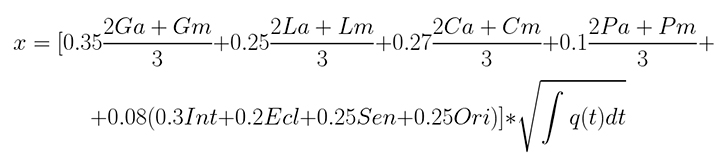
The formula has three major components. The first one scores every track using Groove, Lyrics, Complex, and Perform, blending the arithmetic mean and the median with a 2:1 weight ratio. I tried several ratios, from 1:1 to 3:1. There’ll be another little Easter egg in the Boosty and Patreon bonus section, showing how the rankings would look under the old system versus the new one. Some albums barely move, while others nosedive - or suddenly shoot up. The second part doesn’t care about individual tracks at all and instead evaluates the album as a whole, looking at Integrity, Eclectic, Sensuousness, and Originality.
At the very end there’s a Riemann integral, calculated minute by minute across the album’s runtime. This measures how consistently the artist maintains quality throughout the entire record. The integral multiplies the previous score (both values are <1), simultaneously reaffirming it and acting as a safeguard against certain progressive or avant-garde albums built around a small number of very long tracks. Under the old system, such albums could exploit the formula: if a song contained a few powerful sections, it was scored primarily for those moments, while excessive padding had to be ignored. A good example is “Omnerod - The Amensal Rise” (2023), which sparked debate in my circles: parts of it sound absolutely fantastic, but they’re weighed down by massive, oppressive, and exhausting segments, leaving an overall negative aftertaste. The integral shuts that loophole down.
Why the square root of the integral, instead of the integral itself? Because otherwise the punishment becomes excessively harsh. In theory, the integral equals 1 in a perfect album - something that almost never happens. Taking the square root of sub-unit values creates an asymptotic glide toward 1, softening the penalty and making it meaningful without completely tanking the score.
You might notice that the total weight of the formula adds up to 105%. That’s a side effect of normalization. I picked around 20 benchmark albums with aggregator scores in the 90–97 range: things like “Radiohead - In Rainbows” or “Jeff Buckley - Grace”, and then tuned the weights so they both produced comparable results and matched my intuition about what actually matters in music. If I forced the total weight down to 100%, even 0.850 albums would become rare, which I don’t like. So far, nothing has reached 1.000 or higher - but if it ever does, I’ll just slap a sigmoid (or a similar nonlinear function) onto the formula.
Support future releases by subscribing to the Digest Extra on Patreon.


